
Face masks in the COVID-19 era: A health hypothesis
Source and full article with references:
PMC – US National Library of Medicine National Institute of Health
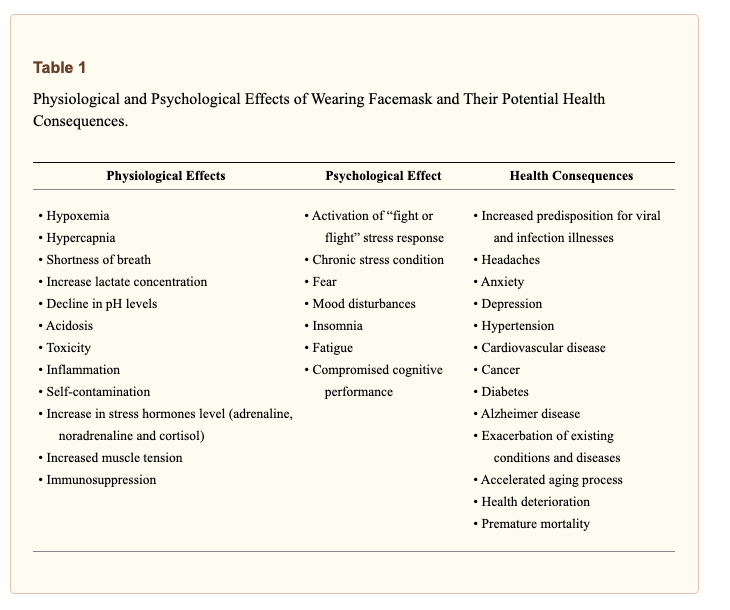
Long-Term health consequences of wearing facemasks
Long-term practice of wearing facemasks has strong potential for devastating health consequences. Prolonged hypoxic-hypercapnic state compromises normal physiological and psychological balance, deteriorating health and promotes the developing and progression of existing chronic diseases [23], [38], [39], [43], [47], [48], [57], [11], [12], [13]. For instance, ischemic heart disease caused by hypoxic damage to the myocardium is the most common form of cardiovascular disease and is a number one cause of death worldwide (44% of all non-communicable diseases) with 17.9 million deaths occurred in 2016 [57]. Hypoxia also playing an important role in cancer burden [58]. Cellular hypoxia has strong mechanistic feature in promoting cancer initiation, progression, metastasis, predicting clinical outcomes and usually presents a poorer survival in patients with cancer. Most solid tumors present some degree of hypoxia, which is independent predictor of more aggressive disease, resistance to cancer therapies and poorer clinical outcomes [59], [60]. Worth note, cancer is one of the leading causes of death worldwide, with an estimate of more than 18 million new diagnosed cases and 9.6 million cancer-related deaths occurred in 2018 [61].
With respect to mental health, global estimates showing that COVID-19 will cause a catastrophe due to collateral psychological damage such as quarantine, lockdowns, unemployment, economic collapse, social isolation, violence and suicides [62], [63], [64]. Chronic stress along with hypoxic and hypercapnic conditions knocks the body out of balance, and can cause headaches, fatigue, stomach issues, muscle tension, mood disturbances, insomnia and accelerated aging [47], [48], [65], [66], [67]. This state suppressing the immune system to protect the body from viruses and bacteria, decreasing cognitive function, promoting the developing and exacerbating the major health issues including hypertension, cardiovascular disease, diabetes, cancer, Alzheimer disease, rising anxiety and depression states, causes social isolation and loneliness and increasing the risk for prematurely mortality [47], [48], [51], [56], [66].
Conclusion
The existing scientific evidences challenge the safety and efficacy of wearing facemask as preventive intervention for COVID-19. The data suggest that both medical and non-medical facemasks are ineffective to block human-to-human transmission of viral and infectious disease such SARS-CoV-2 and COVID-19, supporting against the usage of facemasks. Wearing facemasks has been demonstrated to have substantial adverse physiological and psychological effects. These include hypoxia, hypercapnia, shortness of breath, increased acidity and toxicity, activation of fear and stress response, rise in stress hormones, immunosuppression, fatigue, headaches, decline in cognitive performance, predisposition for viral and infectious illnesses, chronic stress, anxiety and depression. Long-term consequences of wearing facemask can cause health deterioration, developing and progression of chronic diseases and premature death. Governments, policy makers and health organizations should utilize prosper and scientific evidence-based approach with respect to wearing facemasks, when the latter is considered as preventive intervention for public health.